


Picking the right water filter for your home in Australia really comes down to one thing: matching your specific water worries with the right filtration technology.
For most of us in urban areas, a quality activated carbon filter is fantastic for getting rid of that chlorine taste from tap water. But if you’re looking for a more comprehensive solution that tackles everything from fluoride to heavy metals, a reverse osmosis system is the gold standard.
Why Pure Water Is Your Foundation for Wellness
In Australia, it’s easy to take clean drinking water for granted. But what comes out of our taps isn't always as pure as we might hope. Growing awareness around contaminants like chlorine, fluoride, and even other trace pollutants is pushing more health-conscious Aussies to find better solutions. This guide is here to walk you through choosing the perfect water filter for your home.
This isn't just a niche concern anymore. In 2024, the Australian water purifier market hit a value of USD 245.34 million, and it's projected to climb to USD 338.75 million by 2030. That growth is being fuelled by a greater focus on health and questions about ageing water infrastructure, especially in major cities like Sydney and Canberra.
Connecting Water Quality to Your Daily Rituals
Pure water is more than just about staying hydrated; it's an essential, non-negotiable part of a healthy, mindful lifestyle. The quality of your water has a direct effect on everything from the delicate flavour of your morning matcha to how well your body recovers after a tough workout.
Think about how water shows up in your day:
- Mindful Moments: Filtered water dramatically improves the taste of your herbal tea or the purity of the water in your essential oil diffusers, helping to create a more serene space.
- Clean Nutrition: If you're investing in high-quality Teelixir supplements or vegan protein powder, you’ll want to mix them with the cleanest water to get the full benefits.
- Physical Practice: Proper hydration is critical for everything, from a gentle yoga session to an intense recovery plunge in a portable ice bath.
Clean, filtered water elevates every part of your wellness practice. By removing unwanted chemicals and odours, you allow the true flavours and benefits of your healthy choices to shine through.
This guide will introduce you to the main types of filtration systems out there. We’ll frame your decision not just as a home utility upgrade, but as one of the most important foundational wellness practices you can adopt.
Whether you're blending a post-yoga smoothie or just filling up your glass, ensuring your water is pure is a simple but profound act of self-care. To get started, feel free to explore our curated water filter collection.
A Deep Dive Into Water Filter Technologies
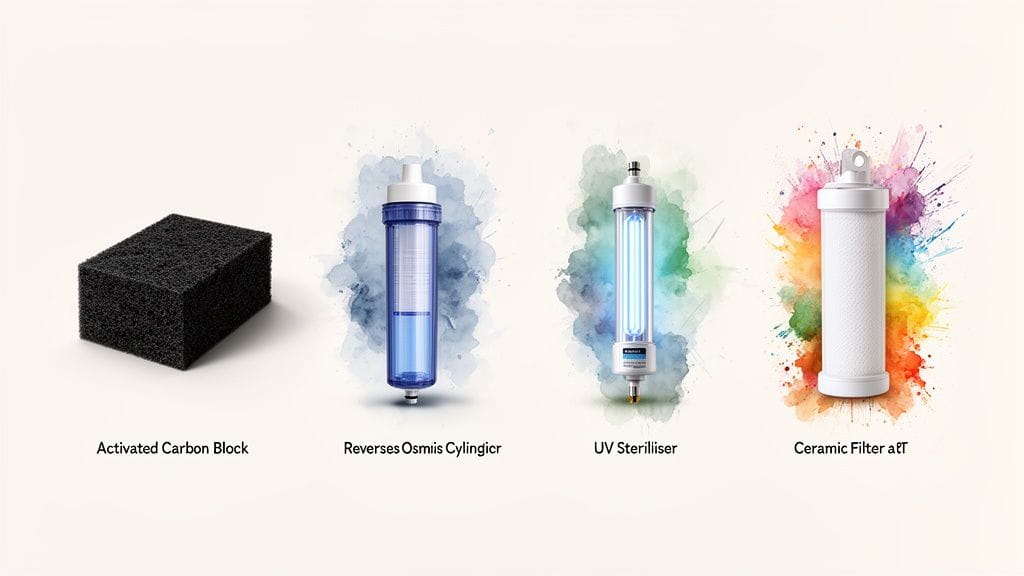
Choosing the best water filter for your home in Australia isn’t just about buying a product; it’s about understanding the science behind how they work. Each technology targets different contaminants, and the right choice for you will come down to your water source and exactly what you want to remove.
Let's break down the most common filtration methods to find the perfect fit for your wellness-focused home.
The Australian water purifier scene is incredibly diverse, reflecting our varied water quality from coast to country. In 2023, the market was valued at a massive USD 193.23 million, with Reverse Osmosis systems leading the pack at a 45% market share. This shows a clear demand for thorough purification, especially as awareness grows around contaminants in both city and regional water supplies.
Activated Carbon Filters: The Taste Improver
Activated carbon is probably the most common and accessible filter you'll come across, found in everything from simple water jugs to more advanced under-sink systems. It works through a clever process called adsorption, where contaminants literally stick to the massive surface area of the carbon as water passes through.
This technology is fantastic at removing chlorine, volatile organic compounds (VOCs), and pesticides. The biggest benefit you'll notice is a dramatic improvement in the taste and smell of your tap water, making it far more enjoyable to drink straight from the tap. For most people in urban areas, it's the perfect starting point to get rid of that chemical taste from municipal water treatment.
However, it's important to know its limits. A standard activated carbon filter won't remove things like heavy metals, fluoride, or dissolved solids.
Reverse Osmosis: The Purity Powerhouse
If you're after the highest possible level of purification, Reverse Osmosis (RO) is the undisputed gold standard. This technology uses a special semi-permeable membrane with microscopic pores. High pressure forces water through this membrane, leaving a huge range of contaminants behind.
An RO system is your best defence against:
- Heavy Metals: Effectively removes nasty stuff like lead, mercury, and arsenic.
- Fluoride: It's one of the few residential methods that can significantly reduce fluoride levels.
- Dissolved Solids: Filters out salts and other total dissolved solids (TDS) that other filters miss.
- Viruses and Bacteria: The membrane is simply too fine for microorganisms to get through.
Because RO is so thorough, it also strips out beneficial minerals like calcium and magnesium. To solve this, many modern RO systems now include a remineralisation stage that adds these healthy minerals back into the water, which also improves its taste and pH balance.
Reverse Osmosis offers total peace of mind by removing the widest spectrum of contaminants. It’s the ideal choice for anyone with serious concerns about their water quality or those wanting to ensure their water is as pure as possible.
UV Sterilisation: For Microbiological Safety
If your main worry is microbiological safety—especially if you're on tank or bore water—then Ultraviolet (UV) sterilisation is a non-negotiable technology. A UV system doesn't actually remove anything. Instead, it uses a powerful UV lamp to zap bacteria, viruses, and protozoa like Giardia and Cryptosporidium.
As water flows past the UV light, the radiation disrupts the DNA of these nasty microorganisms, making them harmless and unable to reproduce. It's a completely chemical-free disinfection method that doesn't change the taste or smell of your water one bit.
UV filters are almost always used with other filter types. For example, you’ll need a sediment filter before the UV lamp to make sure the water is clear. Why? Because suspended particles can create tiny shadows that shield microbes from the light, letting them sneak through. This is a critical point for anyone living off-grid. If this is a key concern for you, you may want to learn more about the specifics of different water filter filters and how they combine.
Ceramic Filters: The Sediment Specialist
Ceramic filters are one of the oldest and most reliable filtration methods around. Made from natural ceramic material, these filters have a complex pore structure that physically blocks sediment, dirt, and larger bacteria from passing through. Think of it as a very, very fine sieve.
Their key strength is their durability and reusability. When the water flow slows down, you can often just take the ceramic cartridge out and give it a gentle scrub to clean the surface, which extends its life considerably. They are brilliant at making cloudy water crystal clear and safe from common bacteria like E. coli.
While they are excellent for sediment and some bacteria, ceramic filters won't remove chemicals, viruses, or dissolved contaminants like heavy metals. They are a fantastic, low-cost option for basic purification, especially in portable or gravity-fed systems, but they are best paired with other technologies for more complete filtration.
Choosing Between Point of Use and Point of Entry Systems
When you're looking to upgrade your water quality at home, one of the first big questions you'll face is this: should you filter all the water coming into your house, or just the water you plan to drink and cook with?
This is the core difference between Point of Entry (PoE) and Point of Use (PoU) systems. Getting this choice right from the start is crucial, as it really comes down to your home, your lifestyle, and what you hope to achieve for your family's wellness.
Point of Use (PoU) filters are your targeted solutions. Think of them as treating water right where you need it—at a single tap in the kitchen or even at your showerhead. These are brilliant for renters, apartment dwellers, or anyone who wants to improve their drinking water quality without committing to a major, permanent installation.
On the other hand, Point of Entry (PoE) systems are the full, whole-house approach. Plumbed in right where your main water line enters your property, they treat every single drop that flows into your home. This is the gold standard for homeowners dealing with widespread water issues or those who simply want comprehensive protection for their entire family and home.
Point of Use (PoU) Filters: The Targeted Solution
PoU filters are all about convenience and addressing specific problems. They come in a few different shapes and sizes, like countertop units that sit next to the sink, under-sink systems that connect to a dedicated small tap, or even simple filters you can attach directly to your existing tap.
Their biggest advantage? They focus on the water you actually consume. This makes them a really cost-effective way to get high-quality, great-tasting drinking water.
For example, maybe you're living in a share house in a city like Melbourne. Your main goal is just to get rid of the chlorine taste and other chemicals in your drinking water. An under-sink carbon filter is the perfect, low-impact solution that won't require a major plumbing overhaul.
Key Insight: Point-of-Use systems let you put your money where it matters most—the water you and your family actually ingest. This makes them a fantastic, budget-friendly first step into the world of water filtration.
Point of Entry (PoE) Systems: The Whole-House Approach
A PoE system is a much bigger commitment, but the payoff is comprehensive, round-the-clock protection. For homeowners, particularly those in regional areas on bore or tank water, a PoE system often moves from a "nice-to-have" to a genuine necessity. It guarantees that every tap in your house delivers clean, filtered water.
The benefits here go way beyond the kitchen. Your showers will feel better with chlorine-free water that’s kinder to your skin and hair. Your appliances, like your washing machine and dishwasher, will be protected from sediment and scale buildup. It's about creating a complete wellness environment in your home.
Installation is definitely more involved and requires a professional plumber. If you're considering a PoE system, it helps to understand what's involved in whole-home water treatment. For instance, reading up on the process of plumbing a water softener can give you a good idea of the work required for these larger installations.
PoU vs PoE Water Filters at a Glance
Use this quick comparison to decide between a targeted Point-of-Use filter and a comprehensive Point-of-Entry system based on your household's unique needs.
| Consideration | Point-of-Use (PoU) Filter | Point-of-Entry (PoE) Filter |
|---|---|---|
| Scope of Filtration | Single tap or outlet (e.g., kitchen sink, shower). | Entire house. Every tap and appliance. |
| Best For | Renters, apartment living, budget-conscious buyers, targeting drinking water. | Homeowners, families, properties with hard water or sediment, bore/tank water. |
| Installation | Mostly DIY. Simple and can be done in minutes to a couple of hours. | Requires a professional plumber. More complex and costly. |
| Initial Cost | $100 - $800. Lower upfront investment. | $1,500 - $5,000+. Significant initial investment. |
| Maintenance | More frequent filter changes (every 6-12 months). Lower cost per filter. | Less frequent but more expensive filter changes (annually or longer). |
| Common Filter Types | Activated carbon, reverse osmosis (under-sink), ceramic. | Large sediment filters, carbon blocks, water softeners, UV systems. |
Ultimately, this table shows there's no single "best" answer—only what's best for you. PoU is about targeted, affordable improvement, while PoE is a long-term investment in your entire home's water quality.
Comparing Costs and Maintenance
The financial and upkeep differences are pretty stark and should be a major part of your decision.
- Initial Cost: PoU systems are far easier on the wallet to start with. You can get a simple filter jug for under $100 or an under-sink unit for a few hundred dollars. PoE systems are a real investment, often costing a few thousand dollars once you factor in professional installation.
- Maintenance: With a PoU system, you’ll be replacing filter cartridges more often—usually every 6 to 12 months. While each cartridge is relatively cheap, those costs do add up over time. PoE systems need less frequent attention, but the replacement filters are larger and more expensive, typically changed annually or even bi-annually.
- Installation: Most PoU systems are designed for easy DIY installation. A PoE system, however, is not a weekend project; it needs a licensed plumber, which adds to the initial expense.
So, how do you choose? It really hinges on your specific situation. If you're a renter just wanting better-tasting water from the kitchen tap, a PoU filter is the clear, economical choice. But if you own your home and are battling hard water stains, sediment in your pipes, or chemical odours from every tap, a PoE system is a smart long-term investment in your property and your family’s health.
To get a better sense of how these systems solve different water problems, you might find it helpful to learn more about choosing the right filter for your water.
Understanding Australian Water Quality Challenges
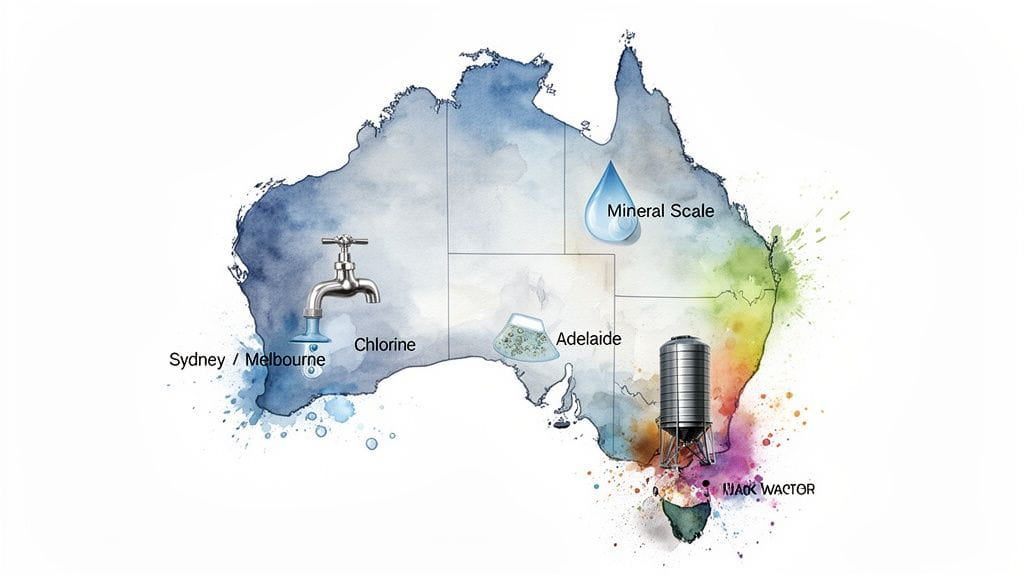
Australia is a country of stark contrasts, and our water quality is no exception. It can change dramatically from one postcode to another. This means finding the right water filter for your home isn't a simple task; you first need to get familiar with the specific challenges in your local supply.
What’s a major concern for a Sydney apartment might be a non-issue for a family home in regional Queensland. This regional variation is exactly why a one-size-fits-all approach to water filtration just doesn’t work in Australia. By identifying what’s actually in your water, you can choose a system that offers targeted, effective protection.
Major City Water Concerns
Even in our biggest cities, the water flowing from our taps is far from pure. It’s treated with a cocktail of chemicals to keep it safe on its long journey from the reservoir to your kitchen. While this is crucial for public health, these additives often impact the taste, smell, and feel of your water.
- Chlorine and Chloramine: These are the go-to disinfectants in cities like Sydney, Melbourne, and Brisbane. They do a great job of killing nasty bacteria, but they also leave behind a distinct chemical taste and odour. This can completely ruin a delicate cup of herbal tea or your morning brew of ceremonial-grade matcha powder. For anyone with sensitive skin, chlorine can also be a real irritant during showers.
- Fluoride: Added to most town water supplies to support dental health, fluoride is something many health-conscious people prefer to remove. Reverse osmosis systems are one of the very few filtration methods that can effectively reduce fluoride levels at home.
- Heavy Metals: If you live in an older home or suburb, there's a risk of lead and copper leaching into your water from ageing pipes. This is a serious health concern, especially for children, and it demands a robust filtration solution.
Regional and Rural Water Challenges
Life outside the big smoke brings its own unique water quality issues, particularly for those relying on bore water or rainwater tanks.
- Hard Water: This is a big problem in cities like Adelaide and Perth, where the water is loaded with minerals like calcium and magnesium. It’s not a health risk, but hard water is notorious for leaving chalky limescale on appliances, clogging up showerheads, and making it nearly impossible to get a good lather from soap.
- Sediment and Turbidity: Bore and tank water often contain fine particles of dirt, silt, and organic matter. This not only makes the water look cloudy and unappealing but can also interfere with other purification methods like UV sterilisation.
- Microbiological Contamination: Unlike treated city water, rainwater tanks and private bores are wide open to contamination from bacteria, viruses, and protozoa like Giardia. This makes a multi-stage filtration system, often including a UV steriliser, an absolute must-have to ensure your water is safe to drink.
For rural households, ensuring water safety isn't just about taste—it's about health. A combination of sediment filters to clear the water and UV sterilisation to neutralise pathogens provides essential peace of mind.
Emerging Contaminants to Watch
Beyond the usual suspects, modern life has introduced a new class of "forever chemicals" and pollutants into our environment and, unfortunately, into our water sources.
PFAS (Per- and Polyfluoroalkyl Substances): These industrial chemicals are incredibly persistent and have been linked to a range of health issues. They are a growing concern, especially in areas near airports, military bases, and industrial sites. High-quality activated carbon and reverse osmosis filters are effective at reducing PFAS levels.
Microplastics: These microscopic plastic particles are turning up everywhere, from the top of Mount Everest to our tap and bottled water. While the long-term health effects are still being studied, many people are wisely looking to minimise their exposure. Investing in high-quality chemical-free water filters is a proactive step towards a purer lifestyle, aligning with conscious choices like using our sustainable, non-toxic yoga mats to reduce chemical exposure in all areas of life.
The Real Cost and Benefit of a Water Filter
Thinking about a water filter for your home in Australia is more than just a purchase; it's an investment in your family's health and peace of mind. While the price tag on a good system might seem steep at first, it’s worth taking a moment to look at the bigger picture and weigh it against the hidden costs of not filtering your water.
When you start to see it that way, a quality filter stops feeling like a luxury and starts to look like a fundamental part of a healthy home. It's about ensuring purity in everything you and your family consume, from a simple glass of water to the veggies you wash for dinner.
Breaking Down the Total Cost of Ownership
The true cost of a water filter isn't just what you pay at the checkout. It's a mix of the unit itself, installation, and the ongoing maintenance needed to keep it running effectively. Getting a handle on these costs helps you make a smart, informed choice.
- Initial Purchase: This can vary hugely. A basic filter jug might only set you back $100 or less. A more robust under-sink reverse osmosis system could be anywhere from $500 to $1,000, while a whole-house system can easily top $2,500.
- Installation: Countertop and tap-mounted filters are generally simple DIY jobs you can knock over in minutes. Under-sink and whole-house systems, on the other hand, will need a licensed plumber, which can add a few hundred dollars to the setup cost.
- Ongoing Maintenance: This is all about the replacement cartridges. For a standard under-sink carbon filter, you might be looking at $80-$150 a year. An RO system could be closer to $150-$250 annually, plus the cost of replacing the membrane every few years.
While those numbers do add up, they often look pretty reasonable when you consider the alternative. Having a constant supply of pure water at your fingertips supports all your other wellness efforts, whether that's properly fuelling your fitness with vegan protein powder or creating a quiet space to deepen your meditation with a zabuton cushion.
Bottled Water: The Hidden Drain on Your Wallet and the Planet
Many of us reach for bottled water thinking it's a purer, safer option. But this habit has some serious financial and environmental downsides that we often don't think about.
Let's do some quick maths. A family buying two 24-packs of bottled water a week at $10 a pack is spending $20 weekly. That quickly blows out to over $1,040 a year. In many cases, that's more than the cost of buying and installing a high-quality under-sink filter in the first year alone.
By the second year, a home water filter isn't just paying for itself—it's actively saving your family money every single day. The long-term savings are substantial, freeing up funds for other wellness priorities.
And then there's the environmental toll. Australia churns through billions of single-use plastic bottles each year, and a staggering number of them end up in landfill or our oceans. Making the switch to a home filter is a powerful, practical step you can take to cut down your household's plastic waste. It's a conscious choice that lines up with a sustainable lifestyle, from the water you drink to the eco-friendly yoga and pilates accessories you use. Choosing filtered tap water is a small, daily vote for a healthier planet.
Your Final Checklist for Choosing a Water Filter
Alright, let's bring it all together. Making the final call on a water filter for your home in Australia really just boils down to taking a clear look at your specific situation.
To cut through the noise, I've put together a final checklist. This isn't about finding one single "best" filter for everyone, but about guiding you to the one that’s a perfect fit for your home, your health goals, and your lifestyle.
This flowchart breaks down how the initial purchase price, ongoing maintenance, and long-term savings all play a part in the total cost.
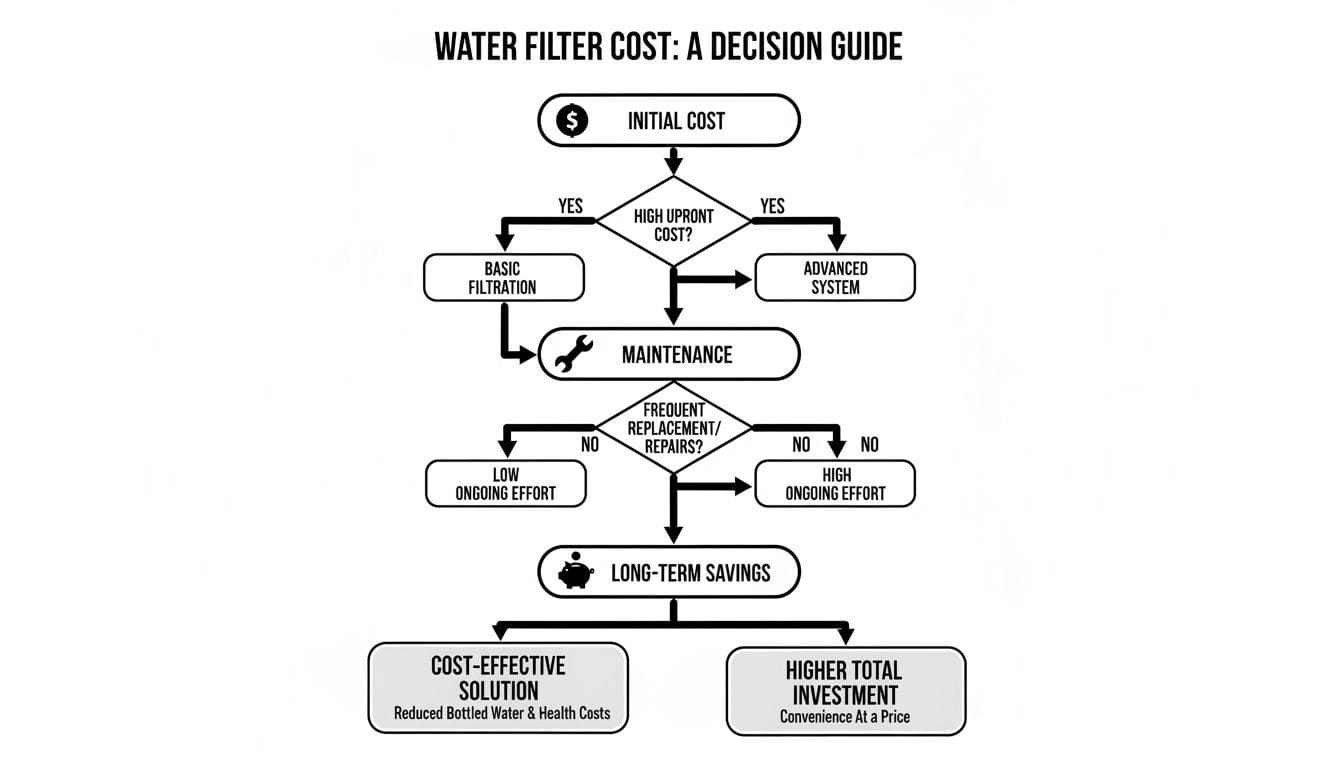
The key takeaway here? A higher upfront cost often means lower running expenses and bigger savings down the track. It helps to think of it less as a purchase and more as a long-term investment in your health.
Your Step-by-Step Decision Guide
Answering these questions honestly will quickly narrow down your options, pointing you directly to the system that makes the most sense.
- What’s my primary water source? Is it treated town water from the tap, or are you on a rainwater tank or bore? This is the most important first step.
- What are my main contaminant concerns? Am I just trying to get rid of that chlorine taste, or do I need to tackle tougher things like fluoride, heavy metals, or bacteria?
- What’s my household size? A single person or a couple will have very different daily water needs compared to a large family. This directly impacts the capacity and type of filter you’ll need.
- What’s my budget for the filter and its upkeep? Make sure you consider both the initial price tag and the ongoing cost of replacement cartridges to understand the true cost over time.
- What are my installation limitations? Are you renting and need something you can just pop on the bench, or are you a homeowner ready to install a more permanent under-sink or whole-house system?
Once you have clear answers to these questions, the path forward becomes much simpler. For instance, a renter in Sydney mainly concerned about chlorine taste just needs a simple countertop carbon filter. On the other hand, a homeowner on a rural property will likely need a multi-stage system that includes UV protection for peace of mind.
This checklist empowers you to make a choice that genuinely enhances your life, ensuring every glass of water supports your commitment to wellness. From improving the taste of your Blue Lotus tea to hydrating after a session in your favourite activewear for women, the right filter makes all the difference.
Ready to find your perfect match? We've curated a selection of premium systems designed for Australian homes.
Discover our curated water filter solutions and take the next step towards a purer, healthier lifestyle.
Got Questions About Home Water Filters? We’ve Got Answers.
Diving into the world of home water filtration can feel a little overwhelming at first. It’s completely normal to have questions! To help you feel confident in your choice, we’ve put together some straightforward answers to the most common queries we hear.
How Often Do I Need to Change Water Filter Cartridges?
This is one of the most common questions, and the honest answer is: it really depends on the type of filter you have and your local water quality.
As a general guide, most activated carbon filters need replacing every 6 to 12 months. The high-tech membranes in reverse osmosis systems are much more durable and can last for 2 to 3 years.
However, if you're in a hard water area like Adelaide or Perth, you’ll probably find your filters clog up faster and need changing more often. The best approach is to always check the manufacturer's guidelines. Following their advice is the only way to guarantee your system keeps performing at its best and your water stays pure.
Will A Water Filter Remove Healthy Minerals?
This is a great question, and it’s a concern we hear a lot, especially regarding powerful systems like reverse osmosis which are designed to remove almost everything from the water. While it's true that some minerals can be removed along with contaminants, many modern filters now come with a dedicated remineralisation stage. This clever feature adds back beneficial minerals like calcium and magnesium after the main purification process is complete.
It's also worth putting this into perspective: we get the vast majority of our essential minerals from a balanced diet, not our drinking water. The immense health benefit of removing harmful substances like lead, chlorine, and PFAS far outweighs any minor loss of minerals from tap water.
Ultimately, filtered water gives you a pure, clean base that supports all your other wellness choices, whether you’re blending a nutritious smoothie with Teelixir superfood powders or brewing a calming cup of tea.
Can I Install A Water Filter Myself?
For many popular filter types, absolutely! Countertop, pitcher, and most simple under-sink models are designed for easy DIY installation. You can usually get them set up and running in under an hour with just a few basic tools.
However, when it comes to whole-house (Point of Entry) systems or the more complex under-sink reverse osmosis units, we always recommend hiring a licensed plumber. Think of professional installation as a smart investment. It ensures your system works perfectly, prevents potential leaks that could cause costly water damage, and makes sure everything is compliant with local plumbing codes. This is especially important for those larger systems that connect directly to your home's main water line. For more tips on creating a healthy home, you can read more on our wellness blog.
At Wellness Apothecary, we truly believe that pure water is the cornerstone of a vibrant, healthy life. It’s such a simple change, but it elevates everything, from your morning matcha green tea powder to your post-workout recovery. Explore our carefully selected range of high-performance chemical free water filters to find the perfect solution for your home.


