


For many people on a wellness journey, a fluoride water filter in Australia is more than just a kitchen appliance—it’s an essential part of a mindful lifestyle. These filters are made to reduce or completely remove fluoride from your tap water, giving you complete control over what you drink and peace of mind about the purity of your home environment.
Why Australians Are Choosing Fluoride-Free Water
Deciding to filter your drinking water is a deeply personal choice, often stemming from a desire to take charge of your health and wellbeing. While water fluoridation is a common public health practice across Australia, a growing number of us are looking for ways to ensure our water aligns with our conscious and healthy lifestyle.
For a lot of people, this decision is just a natural extension of a holistic approach to life. If you’re already carefully choosing organic foods, using eco yoga mats, and relaxing with pure essential oil diffusers, it only makes sense to want that same level of purity from the water you drink and cook with every single day. It’s all about creating a sanctuary at home where every little thing supports your vitality.
The Mindful Approach to Hydration
The modern wellness journey is all about being conscious of what you consume. It means asking questions about what goes into our bodies and actively seeking out the cleanest, most nourishing options we can find. This mindset is what’s leading so many people to look past the tap and think about what’s really in their water.
- Taking Control: The ability to choose what you consume is incredibly empowering. Filtering for fluoride puts you in the driver's seat when it comes to your water quality.
- Purity in Your Rituals: Clean water is the starting point for so many wellness practices. Whether you're brewing a beautiful herbal tea or mixing your favourite Teelixir supplements, beginning with pure water can make all the difference.
- A Foundation for Wellbeing: Just like a clean diet supports your physical health, pure water is seen as one of the most fundamental building blocks for a vibrant life.
As of February 2017, it's estimated that 89% of Australians have access to fluoridated drinking water, with levels managed to support dental health. The National Health and Medical Research Council (NHMRC) has pointed to this as a cost-effective public health measure for decades. However, for many on a wellness path, personal choice and the goal of absolute purity come first.
For someone dedicated to a clean lifestyle, filtering water isn't just about removal; it's about intentional living. It's an act of nourishment that honours the body and aligns with a commitment to total wellness.
This shift in awareness goes beyond just drinking water. As more Aussies investigate chemical free water filters, it’s worth looking at the bigger picture, which includes things like the concerns about fluoride in toothpaste. By taking control of your water, you’re making a powerful statement about your dedication to a pure, mindful, and intentional life.
Understanding Australia's Water Fluoridation Program
Before you can choose the right fluoride water filter in Australia, it helps to know why fluoride is in our tap water in the first place. Australia began adding fluoride to public water supplies decades ago as a sweeping public health measure to tackle a nationwide problem: tooth decay.
The idea was simple. Much like fortifying milk with Vitamin D or bread with folic acid, fluoridating water was seen as an easy, passive way to deliver a dental health benefit to the entire population through a shared resource.
But for many of us on a wellness path, "one-size-fits-all" solutions don't always feel right. If you’re someone who mindfully chooses everything from your calming blue lotus tea to your favourite vegan protein powder, wanting the same level of control over your drinking water is a natural next step.
The History And Regulation Of Fluoride In Australia
Water fluoridation isn’t a new idea in Australia—it’s been a key part of our public dental health strategy since the 1950s. Victoria led the way, with some towns adding fluoride as early as 1953, and the practice soon became standard for most major water suppliers across the country.
This decision was backed by decades of solid research. The National Health and Medical Research Council (NHMRC) has found that water fluoridation can cut tooth decay by 26-44% in children and adolescents and around 27% in adults.
Because of this, Australian water authorities carefully manage fluoride levels, keeping them within a safe and effective range of 0.6 to 1.1 milligrams per litre (mg/L). This is the concentration endorsed by health giants like the Australian Dental Association, the World Health Organization (WHO), and the CDC. You can get a general picture by exploring information from health authorities like the World Health Organization.
A Tale Of Two Approaches: Public Health Versus Personal Choice
So, where does the debate come from? It’s really a story of two different philosophies: the broad-strokes approach of public health and the highly personalised focus of individual wellness.
The public health model is designed for the 'average' person, aiming to provide a baseline of protection for everyone. In contrast, the wellness-oriented individual seeks to optimise their personal environment, removing any elements they deem unnecessary to create a state of pure wellbeing.
It’s not about one being right and the other being wrong. They simply have different end goals.
- Public Health Goal: To give a cost-effective, passive benefit to the whole community, especially those who might not have easy access to dental care.
- Personal Wellness Goal: To create optimal health by consciously curating every single input—including your water—to align with your own health philosophy.
For many, choosing to install a fluoride water filter isn’t about rejecting public health measures. It's about taking ownership of a personal health journey. It’s about having the final say over the most fundamental element of your daily life—the water you drink—and creating a home that truly supports your commitment to a pure, intentional lifestyle.
A Look at Different Fluoride Filtration Methods
So, you've decided you want more control over the purity of your drinking water. That’s a fantastic first step. But figuring out how to actually do it can feel a little overwhelming, especially when looking for a fluoride water filter in Australia. The good news is that it really comes down to a few core technologies.
Each filtration method has its own way of removing fluoride and other contaminants, offering different benefits for your home and your wellness goals. Let's walk through the main options to help you find the one that feels right for you.
This flowchart shows the journey of our tap water, where public health bodies regulate fluoride levels to help reduce tooth decay.
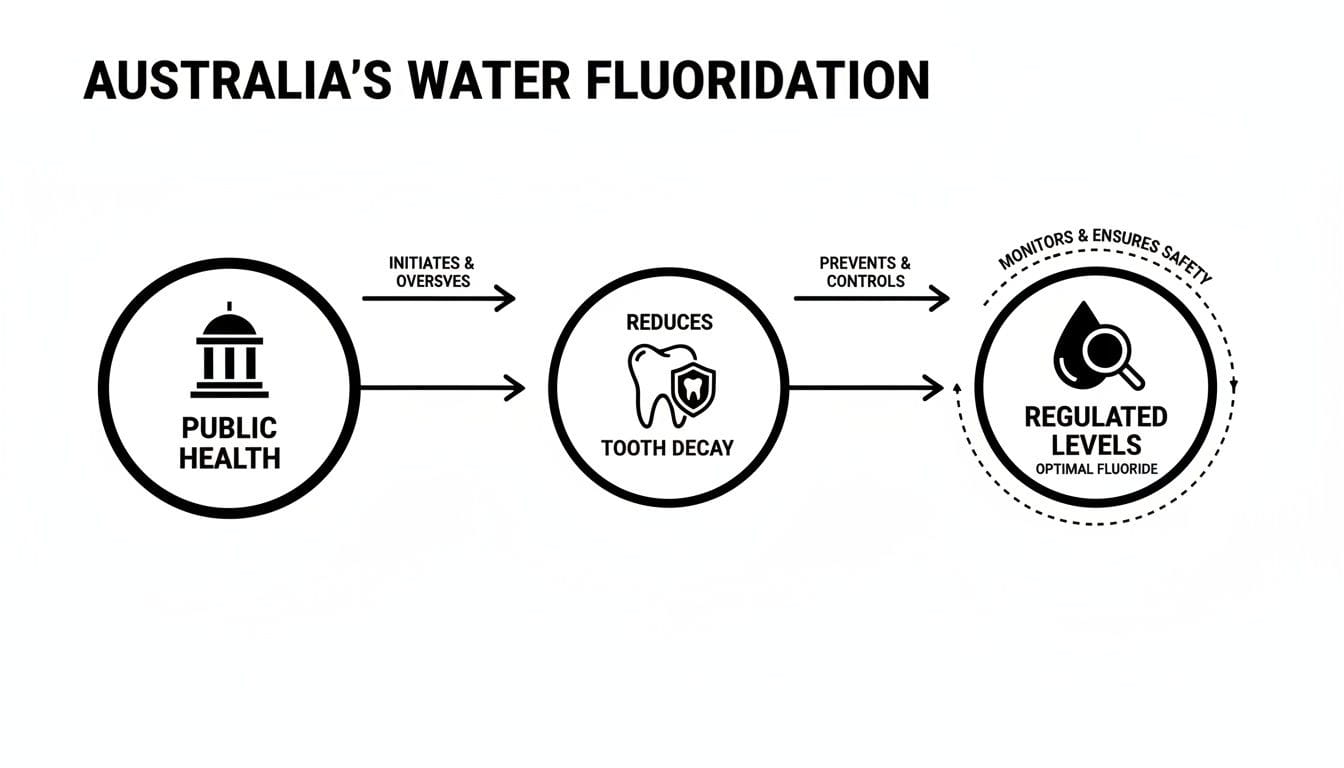
While this is the standard for public water treatment, many of us are now looking to add a personal layer of filtration to achieve that next level of purity at home.
Comparing Fluoride Water Filter Technologies
To make things clearer, this table breaks down the most common fluoride filtration methods available to Australian households. It's designed to help you quickly compare the key differences and choose the right fit for your needs and budget.
| Filtration Method | Fluoride Removal % | Key Benefit | Consideration | Best For |
|---|---|---|---|---|
| Reverse Osmosis | Up to 95%+ | Extremely high purity, removes many contaminants. | Creates wastewater and can remove healthy minerals. | Those seeking the highest possible water purity. |
| Activated Alumina | Up to 90%+ | Specifically targets and adsorbs fluoride. | Cartridges require regular replacement. | Households focused primarily on fluoride reduction. |
| Bone Char | Up to 90% | A natural and traditional method of filtration. | Sourced from animal bones, which may not suit everyone. | Eco-conscious users looking for a natural alternative. |
| Distillation | Up to 99%+ | Produces exceptionally pure water. | Requires electricity and can be a slow process. | People wanting contaminant-free water for specific uses. |
| Ion Exchange | Variable | Can be very effective for fluoride. | Complex and costly; usually for whole-house systems. | Industrial applications or comprehensive home systems. |
Each of these technologies offers a unique approach to water purification. Let's dive a little deeper into what makes them tick.
Reverse Osmosis (RO)
Reverse Osmosis, often just called RO, is the gold standard for water purification. Think of it like a highly exclusive security guard for your water, only allowing the purest water molecules to get through while blocking almost everything else.
The system works by using pressure to force your tap water through an incredibly fine, semi-permeable membrane. This process traps fluoride, heavy metals, chlorine, and a whole range of other dissolved solids, leaving you with exceptionally clean water on the other side.
- Effectiveness: RO systems are remarkably effective, removing up to 95% or more of fluoride. This makes them a top contender for anyone wanting maximum purity.
- Drawbacks: This thorough process does produce some wastewater and also strips away beneficial minerals like calcium and magnesium, though many modern systems have a remineralisation stage to add them back in.
This level of purity is what you want when you're preparing a delicate drink where the water’s taste is crucial—like in our premium matcha green tea powder—it ensures nothing gets in the way of the true flavour.
Activated Alumina
Activated Alumina is a specialised filter material that works like a magnet for fluoride. As water flows through the filter cartridge, fluoride ions are naturally drawn to and stick onto the surface of the alumina beads.
It’s a highly targeted approach, making it very efficient at reducing fluoride levels.
It's important to know that Activated Alumina is not the same as the aluminium you might find in kitchenware. It’s a specific, inert compound (aluminium oxide) that is widely recognised as a safe and effective medium for adsorbing fluoride.
Because the alumina medium eventually becomes saturated, the filter cartridges need to be replaced periodically. How often depends on your local water's fluoride levels and how much water your household uses.
Other Effective Filtration Methods
Beyond RO and Activated Alumina, a few other methods are also great at removing fluoride. You'll often find these in more specialised water filtration systems, each with its own set of pros and cons.
- Bone Char (BC) Carbon: This is actually one of the oldest methods for fluoride removal. Made from charred animal bones, its porous carbon structure is excellent at adsorbing fluoride, heavy metals, and chlorine. It’s a very natural and time-tested option.
- Distillation: A distiller purifies water by boiling it to create steam, which leaves fluoride and other heavy contaminants behind. The steam is then captured and cooled, condensing back into pure liquid water. It's incredibly effective but does use electricity and takes time.
- Ion Exchange: This technology uses a special resin that cleverly swaps fluoride ions for other, more desirable ions (like chloride). While it works well, its complexity and cost mean it's more common in industrial settings or large-scale whole-house systems.
If you'd like to explore how these technologies stack up against filters for other contaminants, our guide on choosing the best water filter for your home in Australia is a great next read.
Ultimately, choosing the right method is about finding a balance between performance, cost, and the maintenance that fits your lifestyle. Whether you need a robust under-sink system for the family or a simple benchtop filter for your apartment, there’s a solution that will fit perfectly into your wellness journey.
How To Choose The Right Filter For Your Australian Home
Alright, you now understand how different filters tackle fluoride. The next step is turning that knowledge into a real-world decision for your own home. Choosing the right fluoride water filter in Australia isn’t about finding one single "best" model—it’s about finding the one that fits your life.
By asking a few simple questions, you can cut through the noise and find a system that feels like it was made for you. This way, your investment truly supports your commitment to pure water, without adding any extra hassle to your day.
What Are Your Primary Wellness Goals?
First, let's get clear on your "why." While removing fluoride is your main objective, thinking about your wider wellness goals will help point you towards the perfect system.
- Maximum Purity: Do you want to remove just about everything? If you're looking for water that's free from not only fluoride but also heavy metals, chlorine, pesticides, and more, a comprehensive system like Reverse Osmosis is likely your best bet.
- Targeted Fluoride Removal: Maybe fluoride is your number one concern, and you're happy with a filter that specifically excels at that. In this case, an Activated Alumina system could be the most direct and efficient solution for you.
- Improved Taste and Odour: Is your main goal simply to get clean, crisp water that tastes and smells great? Most fluoride filters will improve this, but it’s a good factor to keep at the front of your mind.
Knowing what you truly want to achieve makes the choice much easier. After all, the water you drink is the foundation for everything—from rehydrating after a session on your non toxic yoga mat to brewing a restorative cup of herbal tea.
Considering Your Living Situation and Household Size
Your home and the people in it play a massive role in what will work best. What’s practical for a single person renting an apartment is totally different from what a family of four needs in their own home.
Think about your daily reality:
- Are you renting or do you own your home? If you're renting, portable benchtop or pitcher models are fantastic because they don't require any permanent installation. Homeowners, on the other hand, have the freedom to install more powerful under-sink or even whole-house systems.
- How much water does your household use? A large, active family is going to need a filter with a higher capacity to keep up. A smaller household or a couple might be perfectly happy with a more compact benchtop unit.
- How much kitchen space can you spare? Under-sink systems are brilliant for keeping your benchtops clear, but you'll need some cupboard space. Benchtop models are super convenient but will take up a spot in your kitchen.
The ideal filter is one that complements your life, not complicates it. It should deliver pure water exactly when and where you need it, whether that's for filling your bottle before heading out for a run or taking a plunge in a portable ice bath.
Evaluating Budget and Long-Term Maintenance
Finally, let's talk numbers. It's crucial to look at both the initial purchase price and the ongoing costs. A quality water filter is a true investment in your health, so thinking about its long-term value is key.
- Initial Cost: Prices can range from under $100 for a basic pitcher to over $1,000 for a high-end under-sink RO system. It’s a good idea to set a budget that feels right for you.
- Ongoing Maintenance: Every single filter needs its cartridges replaced to stay effective. Before you buy, check the cost of replacement cartridges and how often they need to be changed. A filter might seem cheaper upfront, but could end up costing more over time if its cartridges are expensive or need frequent replacement.
Thinking this through ensures your journey to pure water is a sustainable one that supports your wellbeing for years to come. For a deeper dive into the different models available, our guide on choosing the best water filter for your home in Australia offers even more practical insights.
Integrating Pure Water Into Your Daily Wellness Rituals
A quality water filter is so much more than just another kitchen appliance. Think of it as a quiet partner in your wellness journey, one that weaves itself into the small, meaningful moments of your day. When you choose a fluoride water filter in Australia, you’re doing more than just filtering water; you’re setting a foundation for a cleaner, more intentional lifestyle.
It’s in the little things. That first glass of water you drink to greet the day, the herbal tea you brew to find a moment of calm, or the protein shake you mix after a workout. Pure, filtered water becomes the clean base for all these rituals, making sure nothing gets in the way of their true purpose.
Elevating Your Sensory Experiences
You might be surprised by how much the purity of your water affects taste and smell, especially with delicate preparations. By removing things like fluoride and chlorine, you allow the true flavours and aromas of your favourite wellness practices to come forward.
- Aromatherapy and Essential Oils: When you switch on an essential oil diffuser, you want the pure, clean scent of lavender or frankincense to fill the room. Tap water can leave behind mineral scale that clogs your diffuser, but filtered water creates a clean, consistent mist that lets the real aroma shine.
- Herbal Teas and Tonics: The subtle, earthy notes of a beautiful blue lotus tea or a Teelixir mushroom blend are easily overpowered by the chemical tang of tap water. When you start with pure water, the botanicals can finally express their true character, turning a simple cuppa into a genuinely restorative experience.
This same idea applies to everything from your morning coffee to the water you use for cooking. When you start with a pure base, the end result is always cleaner and more flavourful.
Fuelling Movement and Deepening Stillness
Clean hydration is the bedrock of physical energy and mental clarity. It’s the silent partner that supports you through a tough workout and the quiet companion that helps you settle into meditation.
Investing in pure water is an investment in your performance, recovery, and peace of mind. It’s the essential, often overlooked, element that connects every part of your wellness journey, from vigorous movement to profound stillness.
Think about how filtered water can amplify these daily practices:
- Performance and Recovery: Proper hydration is everything for muscle function and repair. After a challenging yoga class or a session with your Pilates accessories, rehydrating with clean water helps your body recover without any unwanted additives. It also makes the perfect, clean base for your post-workout vegan protein powder, ensuring you’re putting only the good stuff back into your system.
- Meditation and Mindfulness: A clear mind is key to a deep meditation practice. Settling onto your zabuton meditation cushions with a glass of pure water beside you becomes a small ritual in itself—a simple act of purification to help clear away the mental fog and prepare you for stillness.
Ultimately, bringing pure water into your home is about creating a personal sanctuary. It’s a commitment that touches everything, from the vibrant taste of your morning matcha to the comfort of slipping into your favourite women's yoga activewear for a gentle stretch. You can learn more about how different filters work by checking out our other posts on the Wellness Apothecary homepage. Each drop is a small but powerful step towards a more conscious and vibrant way of living. For a deeper look into the world of water filtration, you might also like our dedicated article on water filters.
Answering Your Questions About Fluoride Water Filters
Deciding to filter your water is a big step on your wellness path, but it's completely normal to have a few questions before you dive in. We get it. That's why we've put together some clear, simple answers to the most common queries we hear about choosing a fluoride water filter in Australia. Our aim is to help you feel totally confident as you take back control of your hydration.
Do All Water Filters Remove Fluoride?
This is probably the most important question we get asked, and the answer is a definite no—not all water filters are created equal when it comes to fluoride.
Many standard filters you’ll find in jugs or basic tap attachments use activated carbon. While they do a fantastic job of improving the taste and smell of your water by reducing chlorine, they won't touch the fluoride levels.
To effectively reduce fluoride, you need a filter that uses a specific type of technology. The main players are:
- Reverse Osmosis (RO): A powerhouse method that removes a huge range of contaminants, including up to 99% of fluoride.
- Activated Alumina: This is a specialised media designed to specifically attract and trap fluoride ions as water passes through.
- Bone Char Carbon: A natural and time-tested method that effectively adsorbs fluoride.
- Distillation: This process involves boiling water and collecting the steam, leaving fluoride and other impurities behind.
So, if removing fluoride is your main goal, it's crucial to choose a system that clearly states it uses one of these technologies.
Will I Miss Out On Dental Benefits If I Remove Fluoride?
This is a really thoughtful question and one that comes down to your personal health philosophy. Australian public health bodies stand by water fluoridation as a key strategy for preventing tooth decay across the population.
However, many people who choose to filter out fluoride see it as part of a wider commitment to minimising their exposure to unnecessary additives. They maintain brilliant dental health by being proactive in other ways—think diligent brushing and flossing, a diet low in processed sugars, and regular visits to the dentist. It’s about taking a holistic view of your health rather than relying on one single, passive measure.
How Hard Is It To Install a Fluoride Water Filter?
The good news is there’s a solution for every home and every level of DIY confidence. The installation really just depends on the system you go for.
- Benchtop & Pitcher Filters: These couldn't be easier. You pretty much just unbox them, give the cartridge a quick rinse, and you're good to go. They’re a brilliant choice for renters or anyone who wants great filtered drinking water without any fuss.
- Under-Sink Systems: These require a bit more effort but give you a beautiful, seamless result with filtered water straight from the tap. Many people with basic tool skills can get one installed in an hour or two by following the instructions, but if you'd rather not, a plumber can have it done in no time for complete peace of mind.
Just think about what works best for your home and lifestyle. There's no right or wrong, only the perfect fit for you.
Why Does Filtered Water Taste Better?
So many people tell us the first thing they notice is how much better their water tastes and smells after they install a filter. That clean, crisp flavour comes from removing one key ingredient: chlorine.
Chlorine is added to our town water as a disinfectant to keep it safe on its journey to our homes. While it's great for safety, it often leaves a distinct chemical taste and odour that can be quite off-putting.
A quality water filter strips this away, letting the pure, natural taste of water shine through. This doesn't just make drinking water more enjoyable on its own; it transforms everything you make with it. Your morning coffee is richer, your herbal teas are more delicate, and even a simple smoothie tastes cleaner. It’s one of those small changes that truly elevates your daily rituals.
Ultimately, choosing a fluoride water filter is about aligning your home environment with your wellness goals. It's about personal choice, purity, and the simple, grounding pleasure of drinking clean, delicious water. If you're ready to see how a filter could fit into your life, the Wellness Apothecary homepage is the perfect place to begin.
At Wellness Apothecary, we believe that pure water is the foundation of a vibrant, healthy life. Our curated collection of water filters is designed to help you create a sanctuary in your home, one sip at a time. Explore our range of high-quality water filters today.


