


If you’ve ever walked into a yoga studio, you’ve probably seen them stacked neatly in a corner: unassuming rectangular blocks. But what are they actually for?
Simply put, a yoga block is one of the most versatile props you can own. Think of it as a friendly extension of your own body or a portable, adjustable floor that brings the ground closer to you. It’s a game-changer for making yoga feel more accessible, no matter how flexible you are.
What Yoga Blocks Really Do
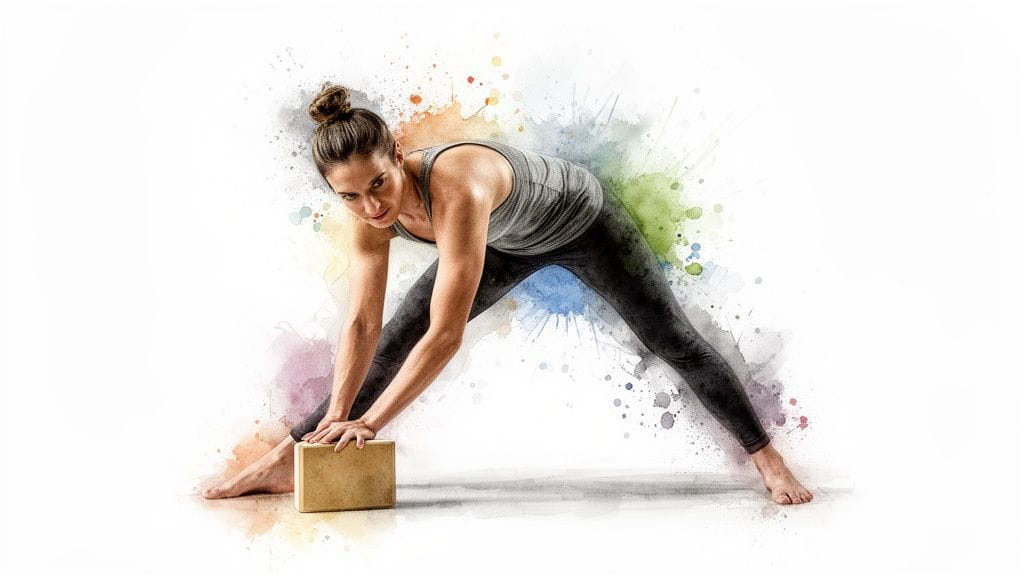
It’s time to bust a common myth: yoga blocks are not a ‘crutch’ or training wheels just for beginners. Honestly, it’s the complete opposite. Far from being a sign of inexperience, using a block is a smart way to deepen your practice. They are powerful tools that bridge the gap between where your body is today and where you want it to go. A block isn’t a shortcut; it’s more like a translator helping your body understand the true purpose of a pose.
By offering support, it lets you hold postures for longer, find stability without straining your muscles, and truly focus on your breath. This makes them invaluable for everyone, from those rolling out their eco-friendly yoga mats for the first time to seasoned yogis working on tricky arm balances.
Bridging The Gap in Your Practice
Picture this: you're in a forward fold, reaching for the floor, but your fingertips are just hovering in mid-air. Sound familiar? By sliding a block under your hands, you bring the floor up to meet you. This small adjustment instantly helps you maintain a long, straight spine instead of rounding your back, allowing your hamstrings to release properly and safely.
Essentially, yoga blocks help you find integrity in a pose before your body has developed the full range of motion. They empower you to feel what correct alignment and muscle engagement are supposed to be like, teaching your body the proper form from day one. This foundation is absolutely crucial for building a sustainable, injury-free practice for years to come.
Feel free to explore our curated collection of yoga blocks to find the perfect support for your journey.
A yoga block doesn't make a pose easier; it makes the pose possible and more effective. It’s about working smarter, not harder, to achieve deeper connection and alignment.
Understanding Block Materials
The material your yoga block is made from really changes its personality. Each type has a different feel, weight, and function, offering unique benefits for different styles of practice. Figuring out which one is right for you is the first step in unlocking its full potential.
Yoga Block Materials At a Glance
Here’s a quick comparison to help you choose the right material for your unique practice needs and goals.
| Material | Key Features | Best For |
|---|---|---|
| Foam | Lightweight, soft, and affordable. Offers a gentle, cushioned feel. | Restorative poses, beginners needing comfort, and travel. |
| Cork | Firm, stable, and eco-friendly. Provides excellent grip and a solid feel. | Standing and balancing poses where stability is key. |
| Wood | The most durable and firmest option. Offers maximum support and longevity. | Advanced practitioners and studios seeking a traditional aesthetic. |
Ultimately, the best material depends on what you need most: the gentle give of foam, the earthy sturdiness of cork, or the unwavering support of wood. Many yogis end up with a couple of different types to suit their mood and practice for the day.
The Real Benefits of Using Blocks in Your Practice
It’s easy to think of yoga blocks as just props, but they’re so much more than that. Think of them as intelligent feedback tools that can totally reshape your practice, improving everything from your physical alignment to your mental focus. A block teaches your body how to engage correctly and find the right posture from the inside out, making your time on the mat safer, more effective, and way more rewarding.
Let's take Trikonasana (Triangle Pose) as an example. So many of us collapse the chest just to get our hand to the floor, which completely defeats the purpose of the pose. But slide a block under your hand? Instantly, you have the lift you need to rotate your torso open, lengthen both sides of your body evenly, and really feel that intended stretch without any strain.
Deeper Stretches Without Force
One of the best things about yoga blocks is how they bring the floor closer to you. In forward folds, this means you can rest your hands on a block instead of letting them dangle or rounding your spine to reach the ground. It’s a simple shift that protects your lower back and allows your hamstrings to release tension gradually and safely.
When you support your body like this, you take the struggle out of the equation. This sends a signal to your nervous system to relax, telling your muscles it’s safe to let go. The result is a much deeper stretch that comes from a place of ease, not force—and that's the key to a practice you can stick with for life. This mindful approach can be enhanced by creating a calming atmosphere with one of our essential oil diffusers.
Using a block isn’t about making a pose easier; it’s about making it more intelligent. It allows you to honour your body's current limitations while still accessing the full benefits and proper alignment of the posture.
Building Functional Strength and Stability
While blocks are amazing for support, they’re also brilliant for adding a bit of a challenge to build functional strength. Try placing a block between your thighs in Bridge Pose or during core work. You’ll immediately feel your adductor (inner thigh) muscles fire up and your core engage on a whole new level. This creates stability right from your centre, which is a game-changer for balance and power.
This kind of targeted engagement builds strength in a really controlled, integrated way that carries over into more advanced poses and even just your daily movements. A strong, stable core is your best defence against injury. For a truly integrated approach, consider pairing your practice with comfortable activewear that moves right along with you.
Ultimately, all these physical perks—safer stretching, better alignment, and more strength—feed into a more mindful practice. When you aren't fighting to hold a pose, you can finally turn your attention inward, focus on your breath, and create a true moving meditation. This is what turns yoga from a workout into a holistic practice for your overall wellbeing.
How To Choose the Right Yoga Block for You
Feeling a bit lost in a sea of options? Don't worry, choosing the right yoga block doesn't have to be complicated. If you focus on just a few key things—material, size, and shape—you’ll find a prop that feels like a natural extension of your practice.
The first big decision is the material. Softer foam blocks are super lightweight and offer a bit of gentle cushioning, which makes them perfect for restorative poses or when you need some support under your back. On the other hand, sturdy cork blocks provide amazing stability and a really satisfying, earthy grip, which is ideal for those tricky balancing poses.
Matching a Block to Your Body and Practice
Beyond the material, the size of the block is crucial. A standard yoga block is cleverly designed with three different height settings: low, medium, and high. This means you can radically change a pose just by flipping the block over, bringing the floor that much closer to you whenever you need it.
Your own flexibility and even the size of your hands will influence what feels best. If you have smaller hands or you’re already quite flexible, a thinner block might feel more comfortable to grip. But if you have larger hands or need that extra bit of height to maintain good alignment, a thicker block will give you the support you need.
To make things even simpler, this visual guide breaks it down based on your primary goal.
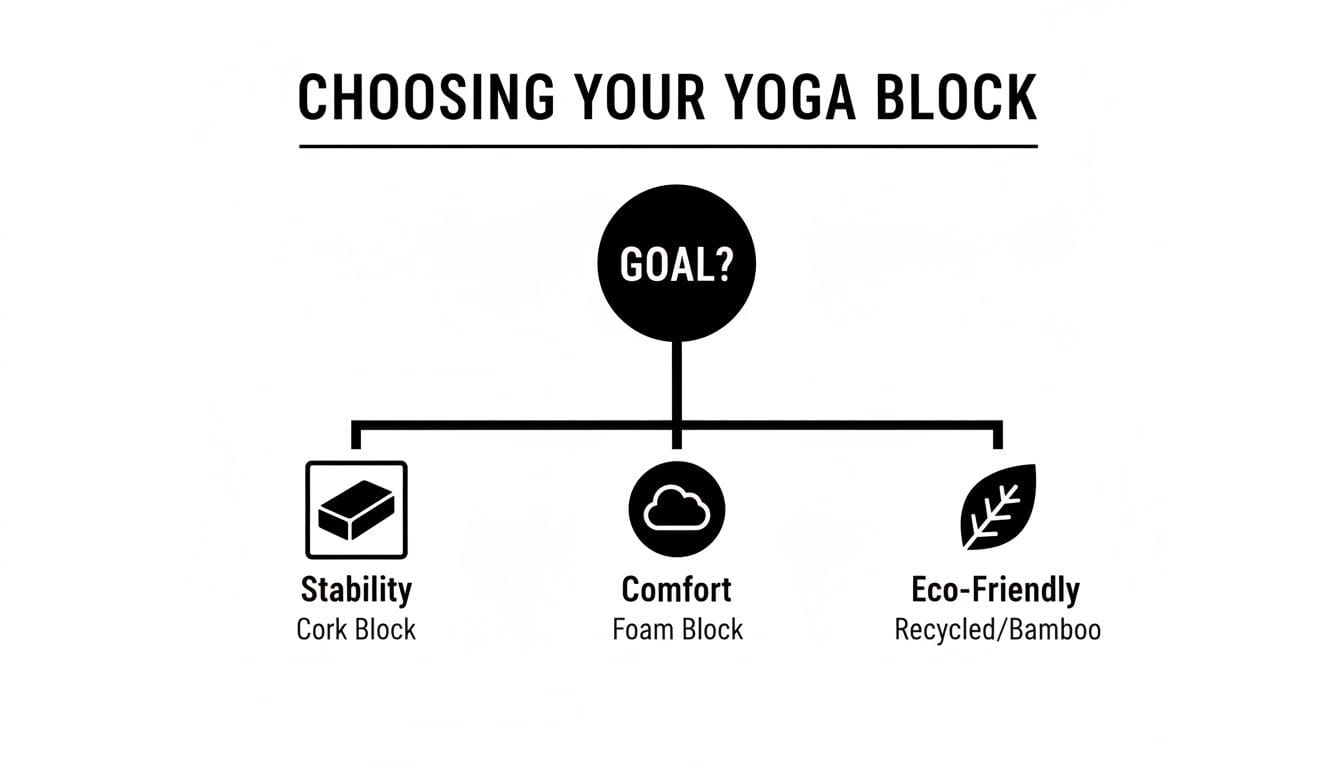
As you can see, your main objective—whether it's stability, comfort, or sustainability—points you directly to a specific block material, taking the guesswork out of your choice.
Investing in Your Practice
Ultimately, the right block is the one that feels secure and helps you hold your alignment without struggling. Think of it as an investment in your safety and progress on the mat.
With home practices becoming so much more popular, the demand for quality props has really grown. In Australia, the market for yoga and Pilates accessories is booming. It’s pretty telling that yoga blocks alone made up a significant portion of this market, which just shows how valuable they are for making poses more accessible for everyone, from total beginners to those recovering from injuries.
Choosing a yoga block is a personal decision. The goal isn't just to buy a prop; it's to select a reliable partner for your practice that helps you find more space, stability, and ease in every pose.
For those who really value an eco-conscious feel combined with unwavering stability, cork is often the top choice. You might be interested in our deep dive into the benefits of cork yoga blocks.
By keeping these simple elements in mind, you'll be well-equipped to find the perfect block to support and elevate your practice.
Putting Your Blocks to Work in 5 Foundational Poses
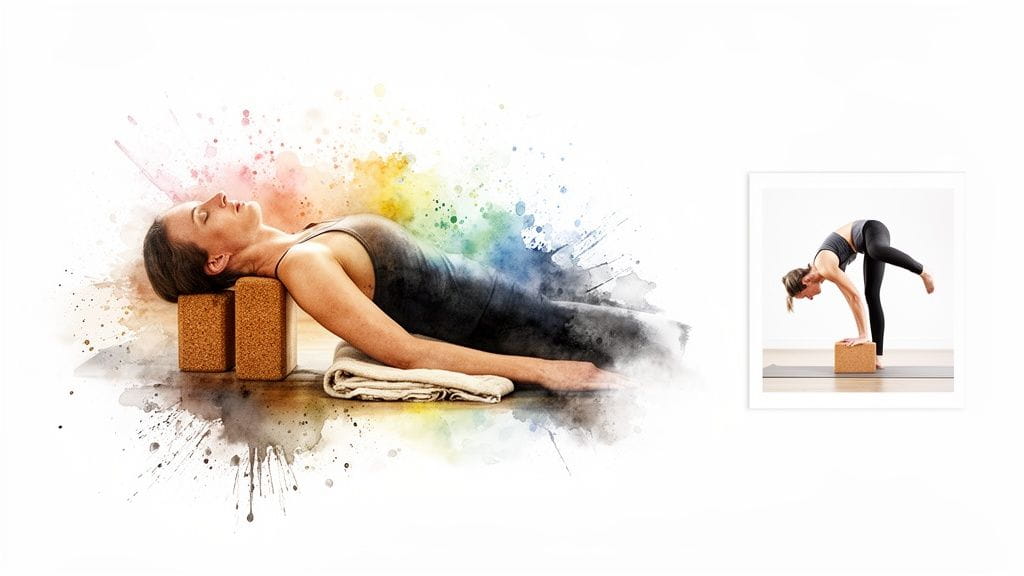
Alright, you've got the theory down. Now it's time to get practical and bring your block onto the mat. Using a block isn't just about making things easier; it’s about unlocking a totally new level of awareness and integrity in each pose.
Here’s a simple, step-by-step guide to weaving a block into 5 of the most common yoga postures.
1. Trikonasana (Triangle Pose)
The whole point of Triangle Pose is to create length along your side body, not to cram your hand down to the floor. This is where a block becomes your best friend, helping you prioritise beautiful alignment over simply going deep.
How to Use the Block:
- Start with a wide stance on your mat. Your front foot points to the top, and your back foot is parallel to the back edge.
- Pop a yoga block on its highest or medium setting just outside your front ankle.
- Hinge forward from your front hip, reaching out and then down to place your hand lightly on the block.
- Gently press into the block. Feel how this helps you rotate your chest open towards the sky, creating a single, long line of energy from your bottom hand all the way to your top hand.
This small tweak stops your chest from collapsing forward and encourages that gorgeous openness across your collarbones. That feeling? That's the heart of the pose.
2. Ardha Chandrasana (Half Moon Pose)
Half Moon is a tricky balance that demands both stability and extension in equal measure. Think of a block under your hand as a steady launchpad, giving you the lift-off and confidence you need to soar.
How to Use the Block:
- From Triangle Pose, place your block about a foot in front of and slightly outside your standing foot.
- Bend your front knee and shift your hand onto the block.
- Slowly, mindfully, lift your back leg until it’s parallel to the floor, keeping the foot flexed and active.
- Once you feel steady, start to open your hips and chest, stacking them one on top of the other as you reach your top arm to the sky.
The block gives you that crucial bit of height, creating space for your hips to open properly and letting you focus on lengthening from your heel right through to the crown of your head.
3. Setu Bandhasana (Supported Bridge Pose)
For a deeply restorative version of Bridge, a block can offer incredible support. It allows for a gentle, passive backbend that melts away tension in the lower back and opens up the chest. After your practice, a portable ice bath can also help with muscle recovery.
How to Use the Block:
- Lie on your back with your knees bent and feet flat on the floor, about hip-width apart.
- Press into your feet to lift your hips from the mat.
- Slide a yoga block (on its medium or lowest height) underneath your sacrum—that flat, bony part at the base of your spine.
- Let your full weight rest onto the block. Relax your arms by your sides and just breathe.
This supported version transforms an active, muscle-building pose into a calming release. It's an absolute dream for soothing the nervous system. You can learn more about props like this by checking out our guide on the adidas eco yoga block.
4. Sukhasana (Easy Pose)
Let's be real—sitting on the floor for meditation can be tough, especially if you have tight hips or cranky knees. Elevating your hips on a block or one of our meditation cushions is a game-changing fix.
How to Use the Block:
- Place a block on its lowest setting on your mat.
- Sit right on the edge of the block, so your sitting bones are supported but you have room to move.
- Cross your legs comfortably in front of you. You'll notice your hips are now higher than your knees, which takes the pressure right off the knee joints and encourages your spine to straighten effortlessly.
This simple adjustment makes sitting for longer stretches so much more comfortable and creates a solid foundation for your meditation practice.
5. Paschimottanasana (Supported Seated Forward Fold)
Straining to grab your toes in a forward fold often leads to a rounded, compressed spine, which defeats the purpose of the stretch. A block helps you maintain length and find a stretch that’s actually productive.
How to Use the Block:
- Sit on your mat with your legs stretched out long in front of you.
- Place a block on its tallest setting just past your feet.
- As you hinge forward from your hips (not your waist!), rest your hands on the block.
- Instead of forcing your head towards your knees, focus on lengthening your spine and breathing into the back of your legs. This allows your body to release tension safely and much more effectively.
Advanced and Restorative Uses for Your Blocks
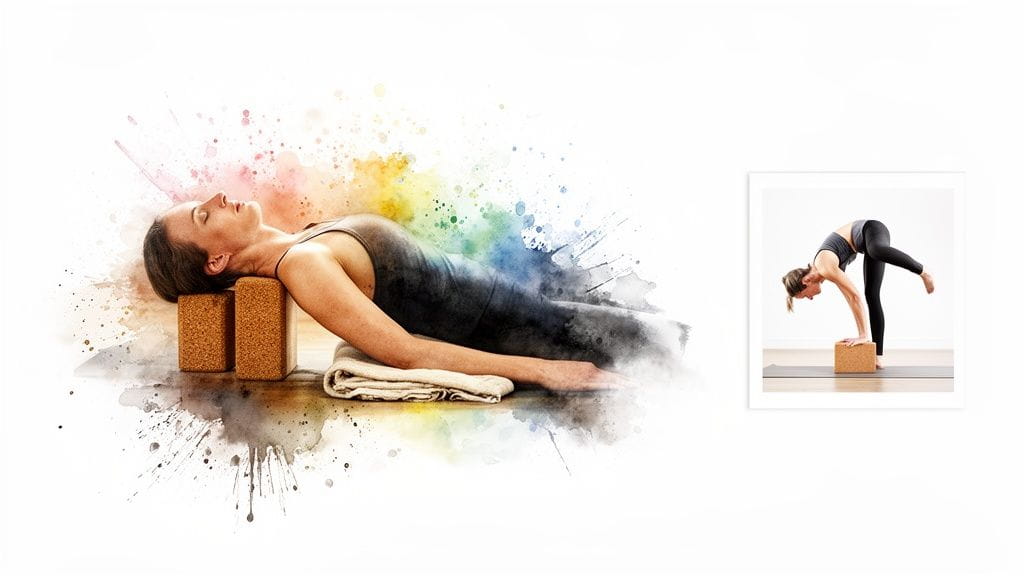
Once you've got the hang of using yoga blocks for basic alignment, a whole new world opens up. They can add a surprising amount of challenge or bring you into a state of deep, blissful relaxation. Far from just being a simple support, blocks are powerful tools for building the strength needed for trickier postures and for completely melting into restorative shapes.
This is what makes them such a non-negotiable prop in my books. They can be a sturdy platform to build confidence for arm balances, or a gentle support that coaxes your body to finally let go.
Building Strength for Advanced Poses
For anyone wanting to build up the strength for arm balances, yoga blocks are like having your own personal trainer. They help you get a real feel for the mechanics of lifting off, all while engaging the right muscles in a much more controlled and accessible way.
A classic example is prepping for Bakasana, or Crow Pose. Try placing your feet on a block. This simple trick elevates your hips, making it so much easier to snuggle your knees high up onto your upper arms. This setup gives you a head start, letting you focus on firing up your core and shifting your weight, without the initial fear of getting off the ground.
You can also use a block to make your core work a little spicier. Squeezing one between your thighs during Boat Pose (Navasana) or leg lifts forces your inner thighs and lower core to switch on, building an integrated strength that will support your entire practice. Powering your body with clean nutrition, like a quality vegan protein powder, can further enhance these strength-building efforts.
Creating a Restorative Sanctuary
On the flip side, yoga blocks are an absolute must for creating deeply restorative and healing shapes. These gentle, supported poses are designed to calm the nervous system and release stored tension. They're perfect after a long day or an intense workout.
When you start arranging your props for a restorative session, you're not just setting up for yoga; you're transforming your space into a personal sanctuary. Combining this with relaxing herbs like our Blue Lotus tea can elevate the experience.
In restorative yoga, the goal isn't to stretch, but to release. Blocks support your body completely, allowing your muscles to relax and your mind to quieten, fostering a state of active relaxation.
A wonderful pose to try is Supported Fish Pose (Matsyasana). Here's how you can set it up:
- Place one block on its medium height where your shoulder blades will eventually rest.
- Place a second block on its highest setting behind the first one. This one is for your head.
- Lie back so the first block gently opens your chest and your head rests comfortably on the second.
- Let your arms fall open to the sides with your palms facing up, and just breathe deeply into your heart space.
This setup creates a gentle backbend that opens up the chest and shoulders—a perfect antidote to all the time we spend slouching over desks and phones. Beyond the physical benefits, blocks can also provide stable support for prolonged comfort during your practice of meditation for stress and anxiety relief.
For an even more cushioned experience in these poses, you might find that a natural kapok-filled yoga bolster offers a softer, more enveloping kind of support.
Your Yoga Block Questions, Answered
Got a few lingering questions about yoga blocks? You're not alone. Let's clear up some of the most common queries we get, so you can step onto your mat feeling completely confident in your props.
How Many Yoga Blocks Do I Really Need?
While one block is certainly better than none, we almost always recommend getting a pair. Having two blocks is a game-changer for symmetrical poses, allowing you to place one under each hand in a forward fold or create balanced support in restorative shapes. It’s all about maintaining that sweet spot of alignment.
Is There a Difference Between a Yoga Block and a Yoga Brick?
Honestly, the terms are thrown around so interchangeably that you don't need to get too caught up in it. Every now and then, you might hear "brick" used to describe a thinner or denser style of block, but for all intents and purposes, they do the exact same job.
Can I Just Use a Stack of Books Instead?
We get this question a lot, but we strongly advise against it. Books can slide, they're often unstable, and they just don't offer the reliable grip or standardised height you get from a proper block. Think of it this way: investing in the right tools is an investment in your safety and the quality of your practice. It lets you focus on your breath, not on a wobbly foundation.
How Should I Clean My Yoga Blocks?
It really comes down to the material. For foam blocks, a little bit of mild soap and water does the trick beautifully. Cork is naturally antimicrobial, so it usually just needs a quick wipe-down with a damp cloth. Keeping your props clean and ensuring you drink from chemical free water filters are simple but important parts of a mindful wellness routine.
At Wellness Apothecary, we believe the right tools can elevate your practice from simple movement to a mindful ritual. Explore the full Wellness Apothecary collection to find the perfect props to support your journey.


