


Think of a full gym that you can roll up and pop in your pocket. That’s pretty much what you get with a resistance band. These simple, stretchy tools are changing the game for workouts all across Australia, whether you’re adding a bit of fire to a yoga flow or powering through a strength session at home.
Your Go-To for a Workout Anywhere
Resistance bands have quickly become a non-negotiable in home gyms, Pilates studios, and even suitcases. It’s easy to see why. Their simplicity is deceptive; these bands are brilliant for building strength, boosting mobility, and even helping with rehab, which makes them a perfect workout buddy for just about anyone.
The explosion of resistance bands in Australia is no surprise. It’s all part of a bigger move towards fitness that’s flexible, accessible, and actually works.
The numbers back it up, too. The Aussie resistance band market was valued at USD 9.94 million in 2024 and is expected to jump to USD 17.92 million by 2033. That’s a steady growth of 6.77% each year, reflecting just how much we’re embracing versatile fitness gear.
So, Why Should Bands Be in Your Routine?
If you’re new to working out or just want a straightforward way to build strength, figuring out how to start strength training is the first hurdle. Resistance bands are one of the best ways to get started. They offer a unique kind of resistance that keeps your muscles firing through a full movement.
The real magic is that unlike weights, which depend on gravity, bands provide constant tension. This means your muscles are engaged for the entire rep, pushing them to build strength and endurance without hammering your joints.
Here’s a quick rundown of why they’re so good:
- Perfect for Any Fitness Level: Whether you’re just starting out or you’re a seasoned athlete, there’s a band with the right tension for you.
- A True Full-Body Workout: You can hit every major muscle group, from your legs and glutes to your arms, chest, and back.
- Boost Your Flexibility: Bands are fantastic for stretching and improving your range of motion, making them a great partner for yoga and Pilates. If you like Pilates, you might find our guide to Pilates ring exercises useful, too.
- The Ultimate Travel Companion: They’re light, compact, and mean you never have to skip a workout, no matter where you find yourself.
Consider this your first step toward a smarter, more adaptable fitness routine. And for gear that moves with you, check out our collection of high-performance women's yoga activewear.
Choosing Your Perfect Resistance Band Type
Walking into the world of resistance bands can feel a bit like picking a tool from a toolbox—each one is designed for a specific job. Not all bands are created equal, and grabbing the right one is your first step to a seriously effective workout.
Understanding what makes each type different is key. It helps you match the band to your fitness goals, making sure every stretch, pull, and press counts. Think of them as specialists for different tasks. Whether you're warming up for a session or pushing for a new personal best, the right band will make all the difference.
This infographic quickly sums up the core benefits that make resistance bands a non-negotiable for anyone after a versatile and portable fitness solution.
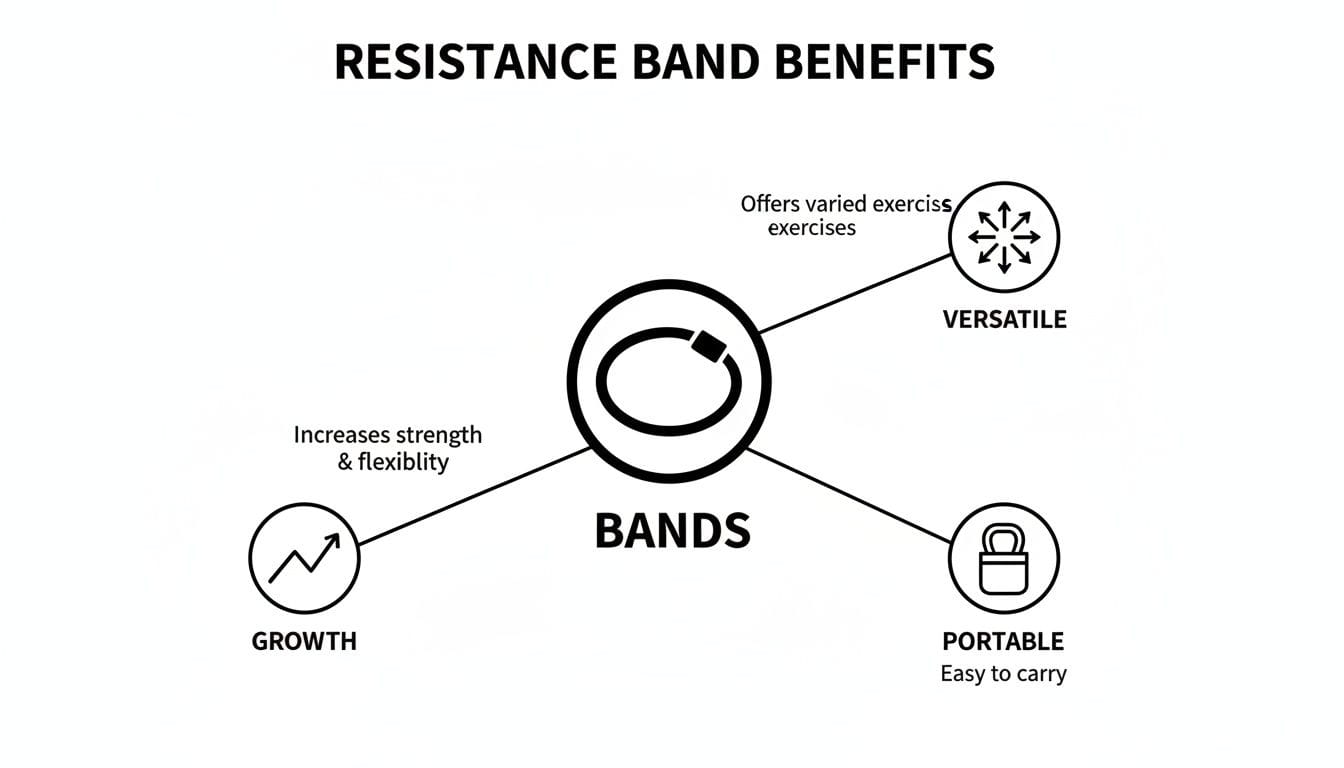
As you can see, their ability to support strength growth, adapt to any workout, and slip into any gym bag makes them an incredibly efficient piece of kit. A meditation cushion can also be a great addition to your post-workout mindfulness routine.
To make it even simpler, here’s a quick rundown of the most common bands you’ll find in Australia.
Resistance Band Types at a Glance
This table gives you a quick comparison of the most common resistance bands, helping you choose the right one for your workout routine.
| Band Type | Primary Use | Best For | Example Exercise |
|---|---|---|---|
| Loop Bands | Strength training, bodyweight assistance | Assisted pull-ups, heavy squats & deadlifts | Looping around a pull-up bar to assist your lift |
| Mini-Bands | Glute & hip activation, lower body toning | Pre-workout activation, adding intensity to squats | Wearing around thighs during a glute bridge |
| Tube Bands | Mimicking free weights, upper body isolation | Bicep curls, chest presses, shoulder raises | Standing on the tube for bicep curls |
| Therapy Bands | Rehabilitation, mobility, gentle warm-ups | Recovering from injury, improving range of motion | Rotator cuff exercises, gentle stretching |
Each band serves a purpose, so choosing one really comes down to what you want to achieve with your training.
Loop Bands (Power Bands)
These are the heavy-lifters of the resistance band family. Loop bands are long, continuous circles of thick, durable latex, and you can think of them as a portable cable machine. Their serious tension makes them perfect for big, compound movements that hit major muscle groups.
- Best For: Assisted pull-ups, heavy-duty leg presses, and adding some real resistance to squats and deadlifts.
- Example Use: Hook one end around a pull-up bar and place your knee or foot in the other to get that extra boost you need to nail the movement.
Mini-Bands (Booty Bands)
You’ve probably seen these smaller, wider loops used for lower-body workouts—and for good reason. Mini-bands are fantastic for waking up and strengthening the glutes and hips, muscles that often get lazy in our day-to-day lives. Most modern options you’ll find in Australia are made from a non-slip fabric, so they won’t roll up your leg mid-squat.
These bands are an absolute must for pre-workout activation or for adding an extra burn to exercises like glute bridges, clamshells, and monster walks. For anyone wanting to really target their lower body, exploring the different ways to use resistance loop bands can completely transform a routine.
Tube Bands With Handles
If you’re looking for something that feels more like traditional gym equipment, tube bands are the answer. These are hollow tubes with handles on each end, making them perfect for exercises where you’d normally reach for a dumbbell, like bicep curls, chest presses, or shoulder raises.
They offer a familiar grip and movement pattern, which can make switching from free weights to bands feel much more natural. They’re excellent for isolating specific upper-body muscles.
Therapy Bands
Finally, we have therapy bands. These are the long, thin, flat strips of latex that don’t form a loop. They offer the lightest resistance of the lot and are typically used for rehabilitation and physical therapy. Their gentle tension is perfect for strengthening smaller stabiliser muscles after an injury, often alongside equipment from a store's range of Pilates accessories.
Finding the Right Tension for Your Fitness Level
Choosing the right resistance band isn't just about picking a colour you like; it’s the key to making safe, steady progress. This is your first step into the world of progressive overload—the simple but powerful principle of gradually increasing the demands on your body to build strength and muscle. Nailing this from the get-go means you can challenge yourself properly without ever risking bad form.
Think about it: the powerful muscles in your legs that you use for squats and lunges can handle a whole lot more tension than the smaller, more intricate muscles in your shoulders. Using the same heavy band for both isn't just inefficient; it's a recipe for injury. Your fitness journey is yours alone, and as you get stronger, your equipment needs to keep up.
So, how do you know you've found the sweet spot? The goal is to find a tension that makes the last two or three reps of any set feel genuinely tough, but not impossible to finish with good technique. If you're breezing through 15 reps without feeling the burn, your band is too light. On the other hand, if you're struggling to complete 8 reps with proper form, it’s too heavy.
Matching Resistance to Your Goals
The perfect band for you really comes down to what you're trying to achieve. Are you warming up for a big lift, building raw strength, or working on muscular endurance? Each goal demands a different approach.
- For Warm-ups and Mobility: Grab a light band. The idea here is to get the blood flowing and gently wake up the muscles, not wear them out before the real work begins.
- For Endurance and Toning: A light to medium band is your best bet. You'll want to aim for higher repetitions (15-20+ reps) to build that lean, toned look and improve muscular endurance.
- For Strength and Muscle Growth: This is where medium to heavy bands shine. They provide the right challenge for lower rep ranges (8-12 reps), which is ideal for hypertrophy (muscle building).
It's no secret that Aussies are embracing bands for all sorts of routines. In fact, market analysts valued the resistance bands in Australia sector at USD 11.2 million in 2022 and project it will jump to USD 27.1 million by 2032. This boom shows just how versatile these simple tools are, finding their way into everything from physiotherapy to yoga. You can discover insights about the resistance bands market here to see the full trend.
A Practical Approach for Beginners
If you're just starting out, your best move is to buy a set of bands with a few different resistance levels. This gives you the freedom to use the right tension for the right job. You can grab a heavy band for your glute bridges and switch to a light one for shoulder rotations, all within the same workout.
A good rule of thumb is to always master your form with a lighter band first. Once you feel confident and the exercise starts to feel a bit too easy, you know it's time to level up to the next band. This is the safest way to guarantee you're always making progress.
Pushing yourself in your workouts is crucial, but so is winding down afterwards. Creating a calming post-workout space with something like an essential oil diffuser can help your body and mind relax, setting you up for a solid recovery before your next session.
Top Exercises to Integrate into Your Routine
Got your perfect resistance band? Great, now let's put it to work. The real beauty of these simple tools is how effectively they target major muscle groups with straightforward movements, building the kind of strength you actually use day-to-day. A few key exercises are all you need for a solid full-body workout or even just a great warm-up before a bigger session.
These movements are designed to be powerful without being complicated, with a big focus on proper form to get the best results and avoid injury. They’re ideal for anyone building a fitness foundation. If you're new to this, our recent article offers a deeper dive into the fundamentals of how to use resistance bands so you can get started safely.
Foundational Lower Body Movements
Your lower body is your engine room. Strong legs and glutes power everything you do, from climbing stairs to smashing your personal bests.
1. Banded Glute Bridges
This is a fantastic exercise for waking up your posterior chain—especially your glutes and hamstrings.
- How to do it: Pop a mini-band around your thighs, just above the knees. Lie on your back with your knees bent, feet flat, and arms at your sides. Push through your heels to lift your hips up, making sure to keep tension on the band by pressing your knees outward. Give your glutes a good squeeze at the top before slowly lowering back down.
2. Banded Squats
Adding a band to your squat makes your hip abductors work overtime, which is brilliant for improving your stability and overall form.
- How to do it: Keep the mini-band just above your knees and stand with your feet about shoulder-width apart. With your chest up, sink into a squat like you’re sitting back into a chair, actively pushing your knees out against the band. Go as low as you comfortably can, then drive back up to the start.
Core and Upper Body Strengtheners
A strong upper body and core are non-negotiable for good posture, balance, and all-around strength. This is where your tube bands or long loop bands really shine.
3. Standing Rows
This move hits all the important muscles in your upper back (think traps and lats), which are absolutely crucial for maintaining good posture.
- How to do it: Anchor your tube or loop band to something sturdy around chest height. Grab the band with both hands, arms straight out, and step back until you feel the tension. Now, squeeze your shoulder blades together and pull the band towards your ribs, keeping your elbows tucked in close. Pause for a second, then slowly return to the starting position.
4. Bicep Curls
It's a classic for a reason. Bicep curls build the arm strength you need for all sorts of pulling and lifting. For an extra boost, consider complementing your training with a quality vegan protein powder to support muscle recovery.
- How to do it: Stand on the middle of a loop or tube band with both feet. Grip the ends with your palms facing forward. Pin your elbows to your sides and curl your hands up toward your shoulders. Squeeze your biceps at the peak of the movement before lowering back down with control.
The demand for resistance bands in Australia is really picking up steam, mirroring a wider trend across the Asia-Pacific region. Forecasts point to steady growth right through to 2030. Bands are used heavily in physical therapy (a 30% share of the market) and are the top revenue generator in general fitness, which makes up 50% of sales.
Remember, the key to any exercise is control. Focus on slow, deliberate movements and feeling the target muscles work. This mindful approach not only prevents injury but also delivers much better results over time.
How to Care for Your Resistance Bands
You’ve invested in some top-quality gear, and just like anything else you value, your resistance bands need a bit of love to keep them performing at their best. Looking after them properly is key to making sure they stay safe, effective, and last for years to come. A few simple habits can protect your investment and, most importantly, prevent a band from snapping when you least expect it.
Taking a moment for maintenance is a principle that really applies to your whole wellness routine. It’s no different from choosing quality nutrition from our Teelixir range or ensuring clean hydration with chemical-free water filters. Caring for your equipment is a vital part of a mindful fitness practice.
Cleaning and Storing Your Bands
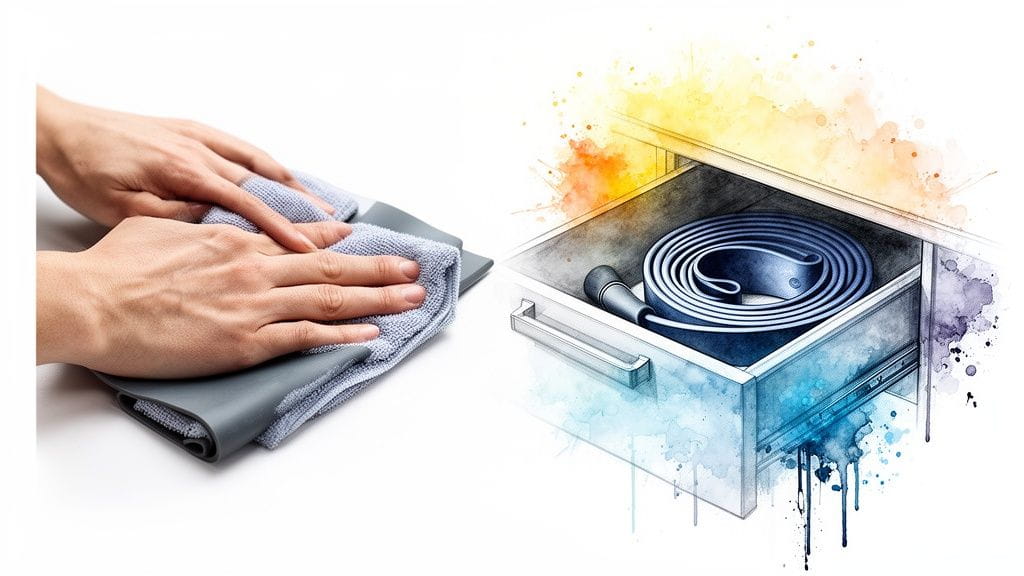
Proper cleaning and storage are the two biggest things you can do to extend the life of your resistance bands. Over time, sweat, dirt, and improper storage can break down both latex and fabric materials, making them weak and unreliable.
For latex bands, a quick wipe-down with a damp cloth is usually all you need. Steer clear of harsh soaps or chemical cleaners, as they can eat away at the material. If you find they get a bit sticky, you can lightly dust them with cornstarch or talcum powder once they're completely dry.
Fabric bands can be gently hand-washed in cool water with just a drop of mild detergent. Make sure you rinse them thoroughly and let them air dry completely before you put them away.
Sun exposure is the number one enemy of latex and elastic. Never leave your bands outside or in direct sunlight. UV rays will make them brittle and cause them to lose their stretch. The best spot for them is somewhere cool and dark, like a drawer or a gym bag.
Regular Inspection for Safety
Before every single workout, get into the habit of giving your bands a quick once-over. This simple check is your best defence against a band snapping mid-exercise, which can cause a nasty injury.
Here’s what you should be looking for:
- Tiny Nicks or Cuts: Run your fingers along the entire surface and the edges. Even a small tear can become a major failure point when the band is under tension.
- Discolouration or Thinning: Keep an eye out for any faded or worn-looking spots. This is a tell-tale sign that the material is starting to degrade.
- Loss of Elasticity: If a band feels less "snappy" than it used to, or doesn't recoil as quickly, it’s losing its strength. That’s your cue to think about replacing it soon.
By catching these early signs of wear and tear, you’re making sure every session isn't just effective, but safe too.
Where to Find Quality Resistance Bands in Australia
So you’re ready to grab some resistance bands and get moving. But with so many options online here in Australia, how do you know you're getting the good stuff? It's not just about finding any band; it's about finding the right one that won't snap mid-squat.
First things first, look at the material. You want something built to last, like high-grade latex or a durable, non-slip fabric. Also, check that the retailer clearly marks the different resistance levels. Nothing's more frustrating than getting a band that's either way too easy or impossible to stretch.
And since you’re likely buying online, pay close attention to the store’s shipping and returns policies. You need to know your gear will arrive without a massive wait, and that you have an easy way to send it back if it’s not quite right.
Finding a Retailer Aligned with Your Goals
Instead of just grabbing the cheapest option from a massive marketplace, think about buying from a store that actually understands your wellness goals. A curated wellness shop is more likely to stock equipment that supports a holistic, high-performance lifestyle.
At Wellness Apothecary, we're all about empowering your fitness journey with simple, effective tools that fit seamlessly into your routine. Our focus is on quality and function, helping you build a sustainable practice you can stick with. We even stock innovative recovery tools like our portable ice baths.
And if you want to create a truly versatile home workout space, think about pairing your bands with other gear. Exploring our collection of yoga blocks and bricks can help expand your exercise options and keep your routines fresh and challenging.
Investing in your fitness means choosing equipment that is not only effective but also reliable. Look for retailers who stand behind their products with clear information and excellent customer support, ensuring your focus remains on achieving your wellness goals.
For those looking to build a complete home gym setup, our 5-piece home workout resistance band set is a fantastic starting point. It offers a full range of tensions to suit any exercise or fitness level, making sure you always have the right tool for the job as you get stronger.
Frequently Asked Questions
Jumping into the world of resistance bands in Australia can feel a bit overwhelming at first. Don't worry, it's normal to have a few questions. We’ve put together answers to the most common queries we hear, so you can feel confident you're making the right choice.
Can I Actually Build Muscle with Just Resistance Bands?
Yes, you absolutely can. Resistance bands are a fantastic tool for building muscle—a process called hypertrophy. They work by creating constant tension throughout an exercise, forcing your muscles to work harder and adapt, which is exactly what leads to growth.
The trick is to keep challenging your body through progressive overload. You can do this by moving up to a stronger band, adding more reps, or even just slowing down your movements to increase the time under tension. They're especially brilliant for toning and developing lean muscle mass, making them perfect for getting stronger anywhere, anytime.
Are Fabric or Latex Bands Better?
This is a classic question, and the honest answer is: it depends on your workout. Both types have their own strengths, and one isn't necessarily "better" than the other.
-
Latex Bands: Think of these as your all-rounders. They're super versatile, offering a huge range of motion and stretch. This flexibility makes them ideal for upper body exercises, mobility drills, and dynamic full-body movements where you need that extra give.
-
Fabric Bands: These are often called 'booty bands' for a good reason. They're wider, tougher, and have a non-slip inner lining. This design is a game-changer for lower body workouts like squats, glute bridges, and hip thrusts, as it stops the band from rolling up your legs mid-rep.
For a truly well-rounded routine, many fitness lovers find having a set of each is the way to go. You can just grab whichever one suits the exercise you're doing that day.
How Often Should I Replace My Bands?
A good quality resistance band can last for several years if you look after it properly. The most important thing is to get into the habit of giving your bands a quick check before each workout. Look for any small tears, nicks, or thinning spots, especially around the areas that get stretched the most.
If you spot any damage, no matter how small, it’s best to replace the band straight away. This prevents it from snapping unexpectedly while you're using it. Storing them out of direct sunlight and giving them a gentle clean now and then will also go a long way in extending their lifespan, keeping your workouts safe and effective.
At Wellness Apothecary, we believe that having the right tools is the first step on any fitness journey. From our carefully selected eco yoga mats to our premium supplements like organic Matcha tea, everything we offer is chosen to help you build a balanced, empowered, and healthy lifestyle.


